

On July 20, 2026, the Department of Homeland Security published a final rule that rewrites how the public charge ground of inadmissibility will be decided. The new public charge rule takes effect on September 18, 2026, and it applies to adjustment of status applications filed on or after that date. For families in the middle of a green card journey, timing now matters more than it has in years.
This article explains what public charge means, what the 2026 rule actually changes, which benefits can be considered, who is exempt, and the practical steps worth taking now.
| Key dates | What happens |
|---|---|
| July 20, 2026 | Final rule published in the Federal Register |
| September 18, 2026 | Rule takes effect. It applies to adjustment of status applications filed on or after this date, and new form editions arrive before it |
| Before September 18, 2026 | Applications filed before this date are assessed under the 2022 framework and use the current Form I-485 edition |
What public charge means
Public charge is a ground of inadmissibility in the Immigration and Nationality Act. In plain terms, the government may refuse a green card to someone it believes is likely at any time to become primarily dependent on public support. Most family based green card applicants, including spouses of US citizens, are subject to this test.
What the 2026 rule changes
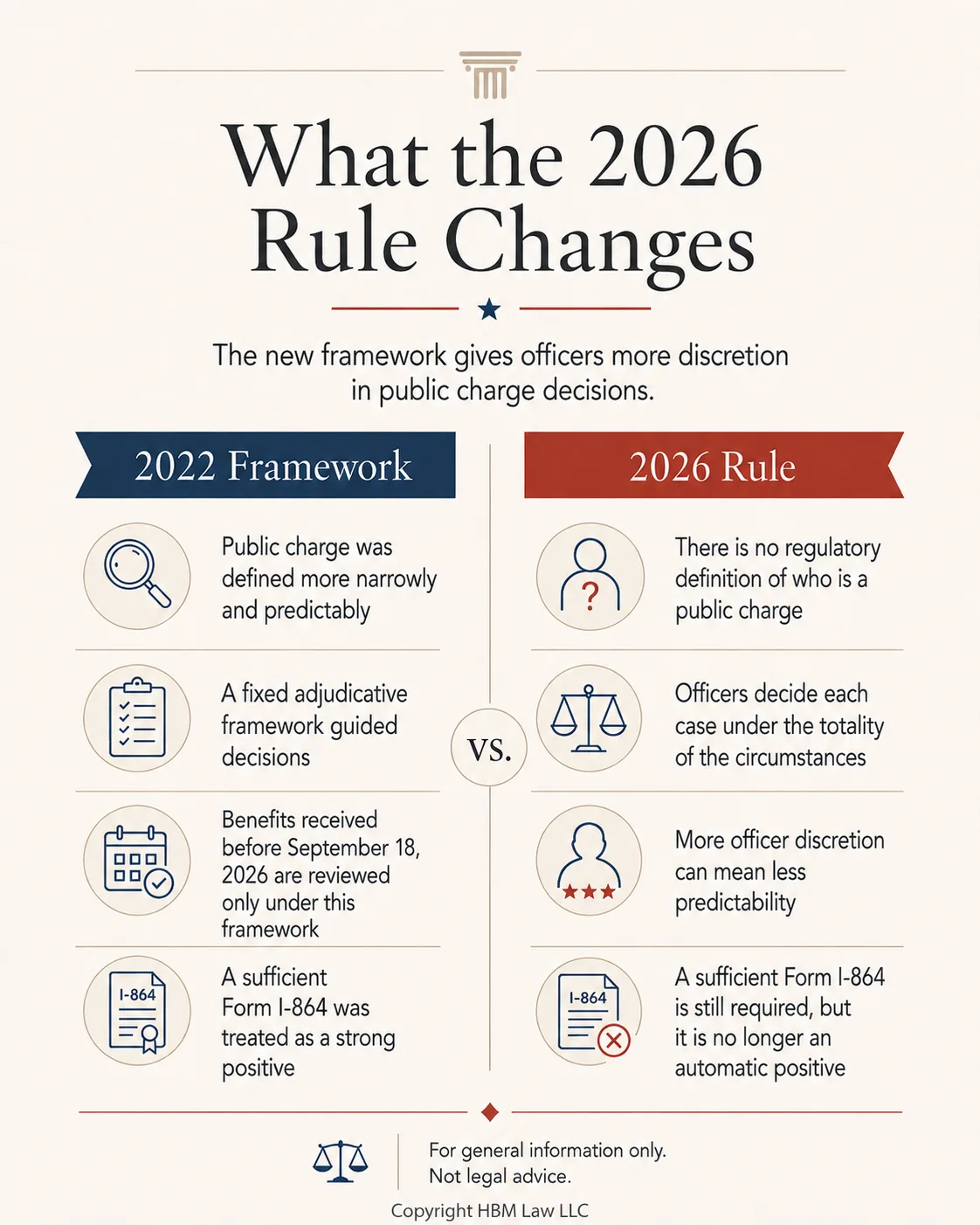
The 2026 Final Rule rescinds the regulations created in 2022, which had defined public charge narrowly and predictably. Under the new rule there is no regulatory definition of who is a public charge and no fixed adjudicative framework. Instead, officers will decide each case in the totality of the circumstances, guided by agency policy that USCIS is expected to release before the effective date. In practice this means significantly more officer discretion, and the possibility of different outcomes on similar facts.
The factors officers must weigh
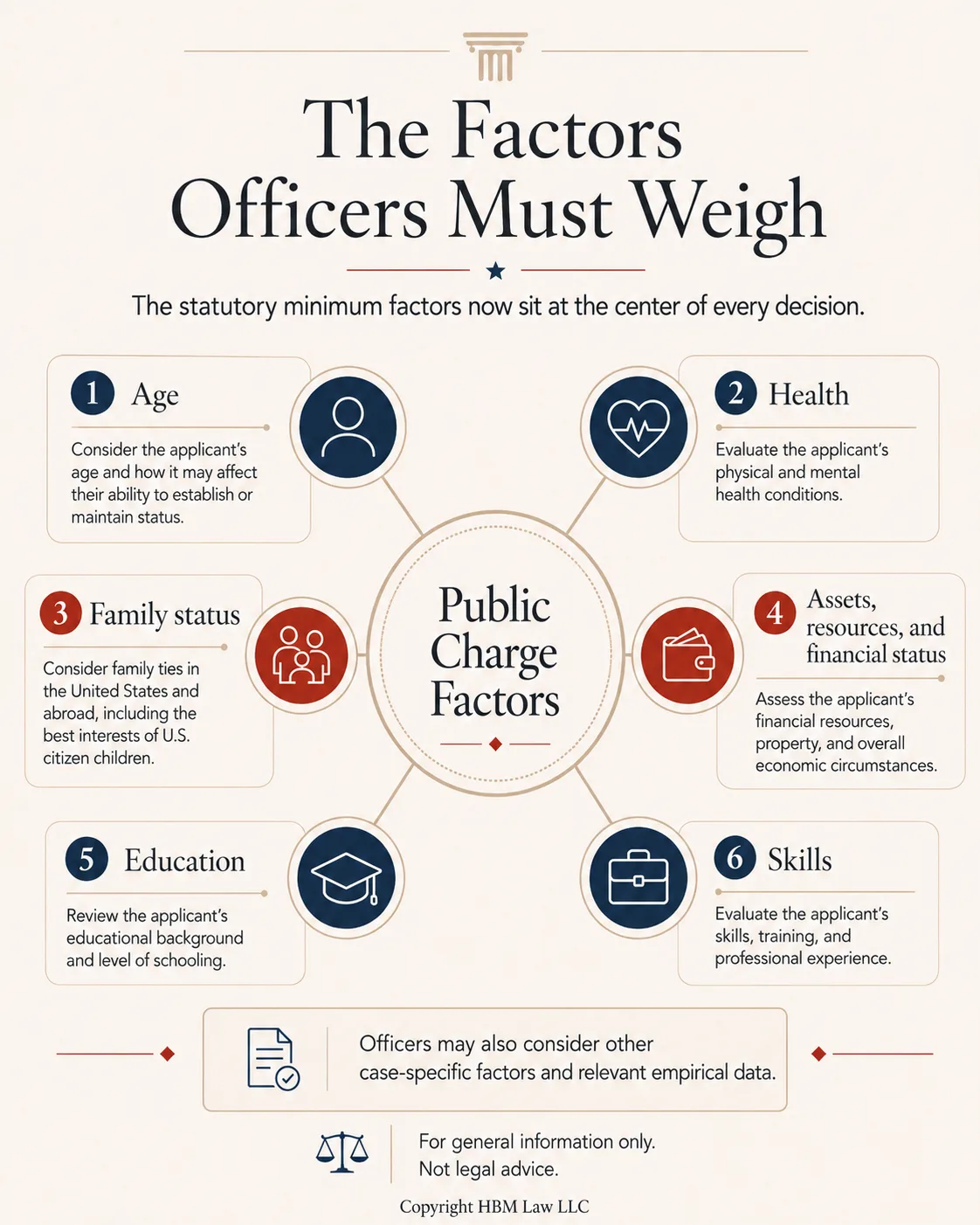
The statutory minimum factors move to the center of every decision: age; health; family status; assets, resources, and financial status; education; and skills. The rule also directs officers to consider any other individualized case specific factors and any empirical data relevant to a person’s self sufficiency. What that last phrase means in practice will only become clear as guidance and adjudications emerge.
Which benefits can be considered
This is the change families feel most directly. For benefits received on or after September 18, 2026, the review broadens to a wide range of means tested programs across federal, state, local, and tribal governments, including non cash programs. The rule discusses examples such as CHIP, WIC, housing assistance, school lunch programs, and Head Start, and it also discusses means tested tax benefits such as the Earned Income Tax Credit and the Child Tax Credit.
There is an important protection on timing: benefits received before September 18, 2026 are assessed only under the 2022 framework, which counted just two things, public cash assistance for income maintenance and long term institutionalization at government expense. USCIS has stated that the Form I-485 instructions will be updated so applicants do not need to report other benefits received before the effective date.
Benefits used by your family members
The rule does not make a family member’s lawful benefit use a direct factor against you. It can, however, enter the analysis in limited circumstances through the assets, resources, and financial status factor, for example where a household member’s benefits reflect that your income falls below a threshold, or where those benefits are shown to be the source of your own support. Families should not make disenrollment decisions out of fear without case specific advice, because walking away from benefits your US citizen children lawfully receive may be unnecessary.
The affidavit of support is no longer an automatic positive
Where the law requires a Form I-864 Affidavit of Support, it is still required, and an insufficient affidavit still leads to a public charge finding. What has changed is the weight of a sufficient affidavit: officers now have discretion to consider it, or not, based on the facts of the case. A strong sponsor remains essential, but it is no longer treated as a near guarantee on this issue.
Who is exempt
Public charge does not apply to US citizens at all. Certain categories of applicants are exempt by statute, including asylees, refugees, and applicants under the T, U, and VAWA programs, among others. Most current green card holders are not reviewed for public charge unless they are treated as applicants for admission. Many nonimmigrant categories, however, remain subject to the test.
What we are already seeing
Attorneys around the country are reporting noticeably more public charge questions in adjustment of status interviews even before the rule takes effect. Once it does, the reasonable expectation is more Requests for Evidence, more Notices of Intent to Deny, longer processing, and denials that must state their basis in writing. The climate rewards applicants who file complete, well documented cases.
What you can do now
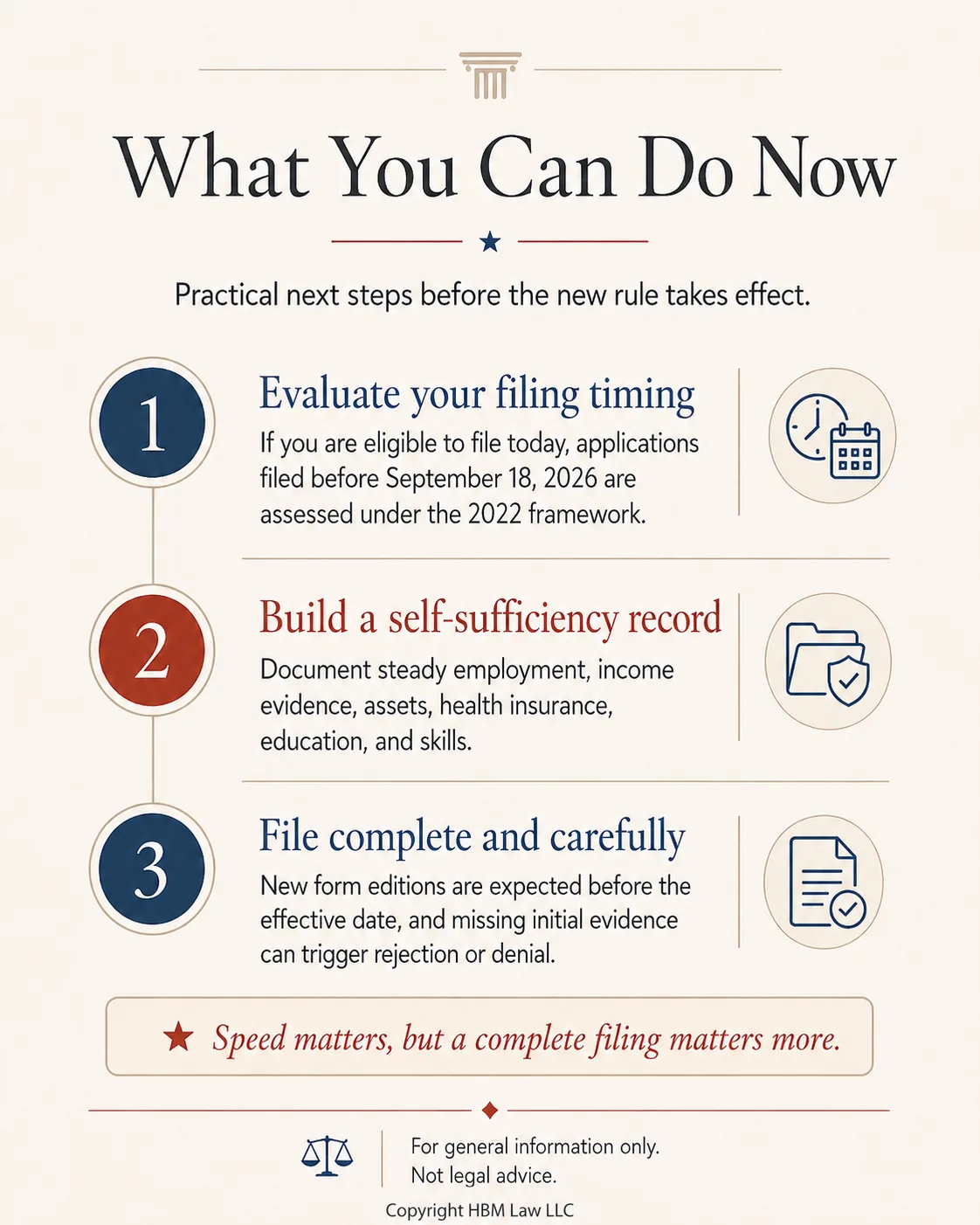
First, if you are eligible to file today, have your case evaluated promptly. Applications filed before September 18, 2026 are assessed under the 2022 framework and use the current Form I-485 edition. New editions of Form I-485 and the public charge bond forms are expected before the effective date, and filing on an outdated edition after the change risks rejection.
Second, build the self sufficiency record regardless of when you file: steady employment history, income evidence, assets, health insurance, education, and skills all now carry direct weight.
Third, file complete. Under a separate August 2026 policy change, USCIS may deny a filing that lacks required initial evidence without first asking for it. Speed matters, but a complete filing matters more.
Frequently asked questions
Does the new rule apply to my case if I already filed?
No. The rule applies to adjustment of status applications filed on or after September 18, 2026. A case filed before that date is assessed under the 2022 framework, although interview questions on financial matters may still be more probing than in past years.
Do we need to stop benefits our US citizen children receive?
The rule does not require anyone to give up benefits they lawfully qualify for, and a family member’s benefits are considered only in limited circumstances. Before disenrolling from anything, get advice on your specific facts.
Is the affidavit of support still required?
Yes, wherever the law required it before. An insufficient affidavit still results in a public charge finding. What has changed is that officers now have discretion in how much positive weight a sufficient affidavit receives.
The bottom line
The 2026 public charge rule replaces bright lines with discretion. That is precisely the environment in which preparation, documentation, and experienced judgment change outcomes. If a green card filing is in your family’s near future, schedule a consultation with Attorney Himani for case specific assessment.
Our companion guide, adjustment of status after marriage and why September 18 matters, covers what this means for married couples specifically.
Legal citation: Public Charge Ground of Inadmissibility Final Rule, 91 Fed. Reg. 45327 (July 20, 2026), effective September 18, 2026.
This article provides general information about recent changes in immigration law and policy. It is not legal advice and does not create an attorney client relationship. Immigration outcomes depend on the specific facts of each case. For advice about your situation, schedule a consultation with a licensed immigration attorney.