

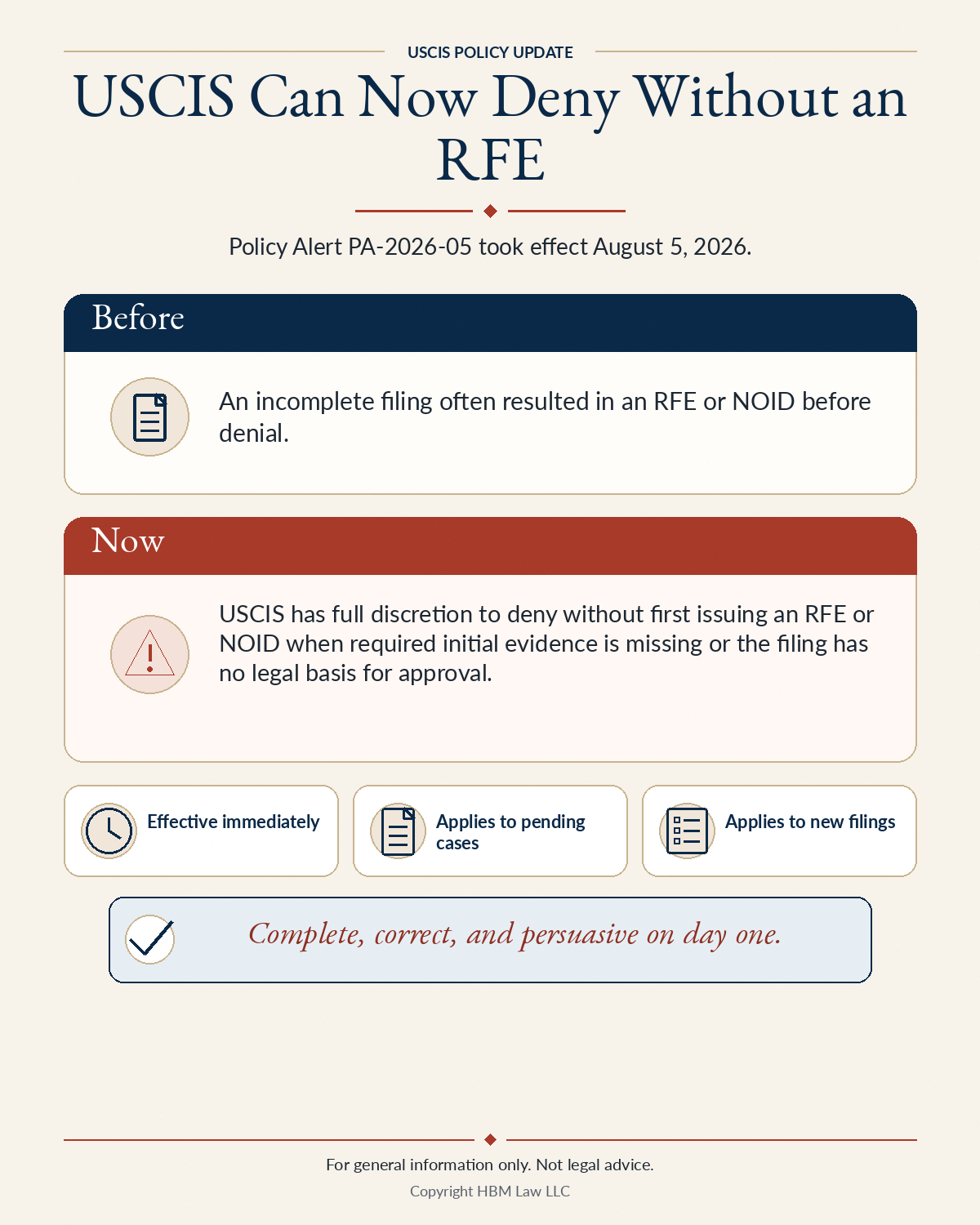
On August 5, 2026, USCIS issued Policy Alert PA-2026-05, changing how officers handle evidence, Requests for Evidence, and Notices of Intent to Deny. The change took effect immediately and applies to cases already pending as well as new filings. In one sentence: if a filing is missing required initial evidence, USCIS may now simply deny it, without first giving you a chance to fix it.
First, the vocabulary
A Request for Evidence, or RFE, is USCIS asking for more documentation before deciding a case. A Notice of Intent to Deny, or NOID, is a formal warning that the case is heading toward denial unless the applicant responds convincingly. For years, standard practice was to issue one of these before denying a case that arrived incomplete. That safety net has now been substantially removed.
What actually changed
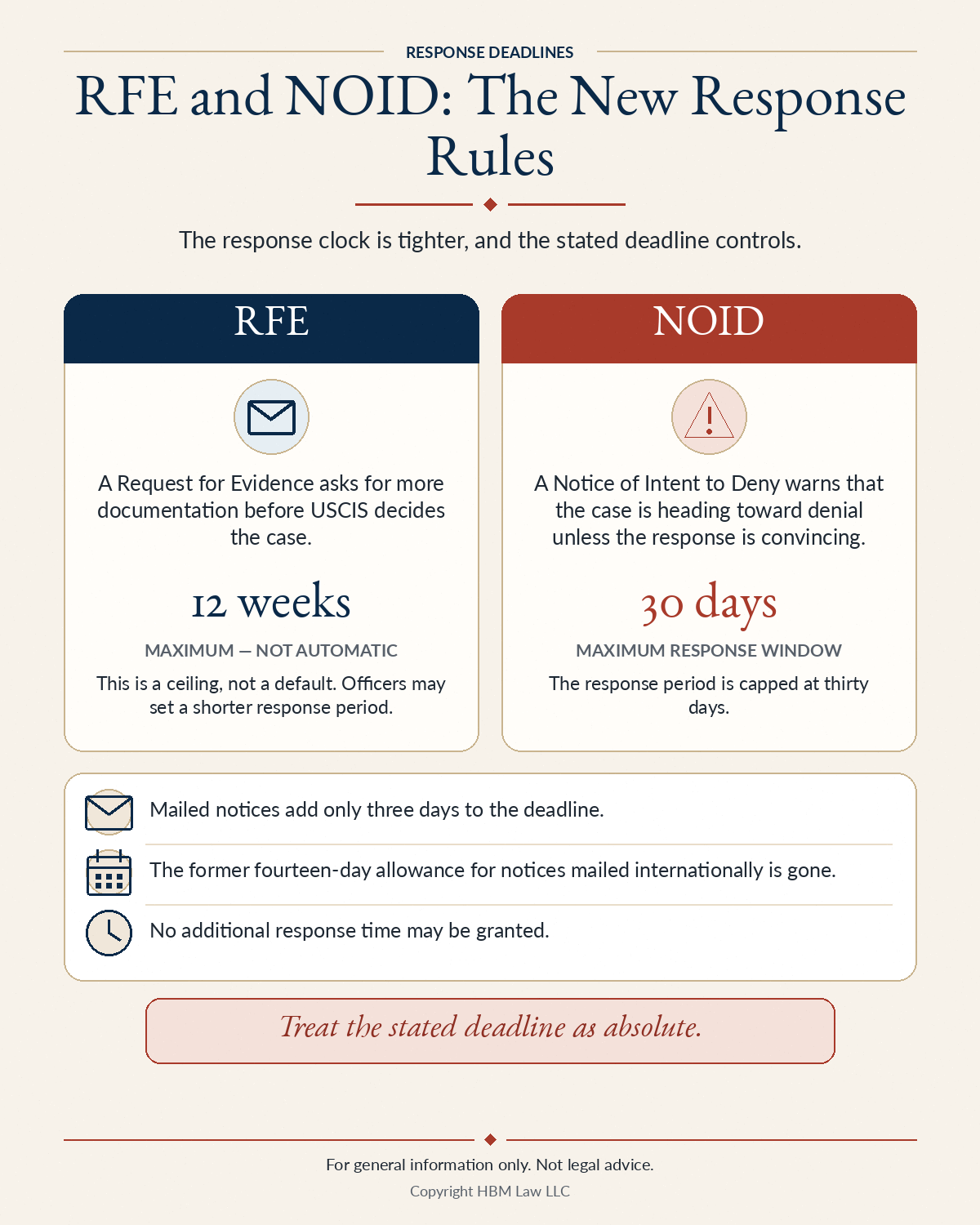
The policy restores officers’ full discretion to deny a benefit request without first issuing an RFE or NOID where the filing lacks required initial evidence or has no legal basis for approval. It also tightens the clock. The twelve week RFE response period is now a ceiling rather than a default, so officers may set shorter deadlines. NOID responses are capped at thirty days. No additional response time may be granted. Mailed notices add only three days to the deadline, and the extra fourteen days that used to apply to notices mailed internationally is gone.
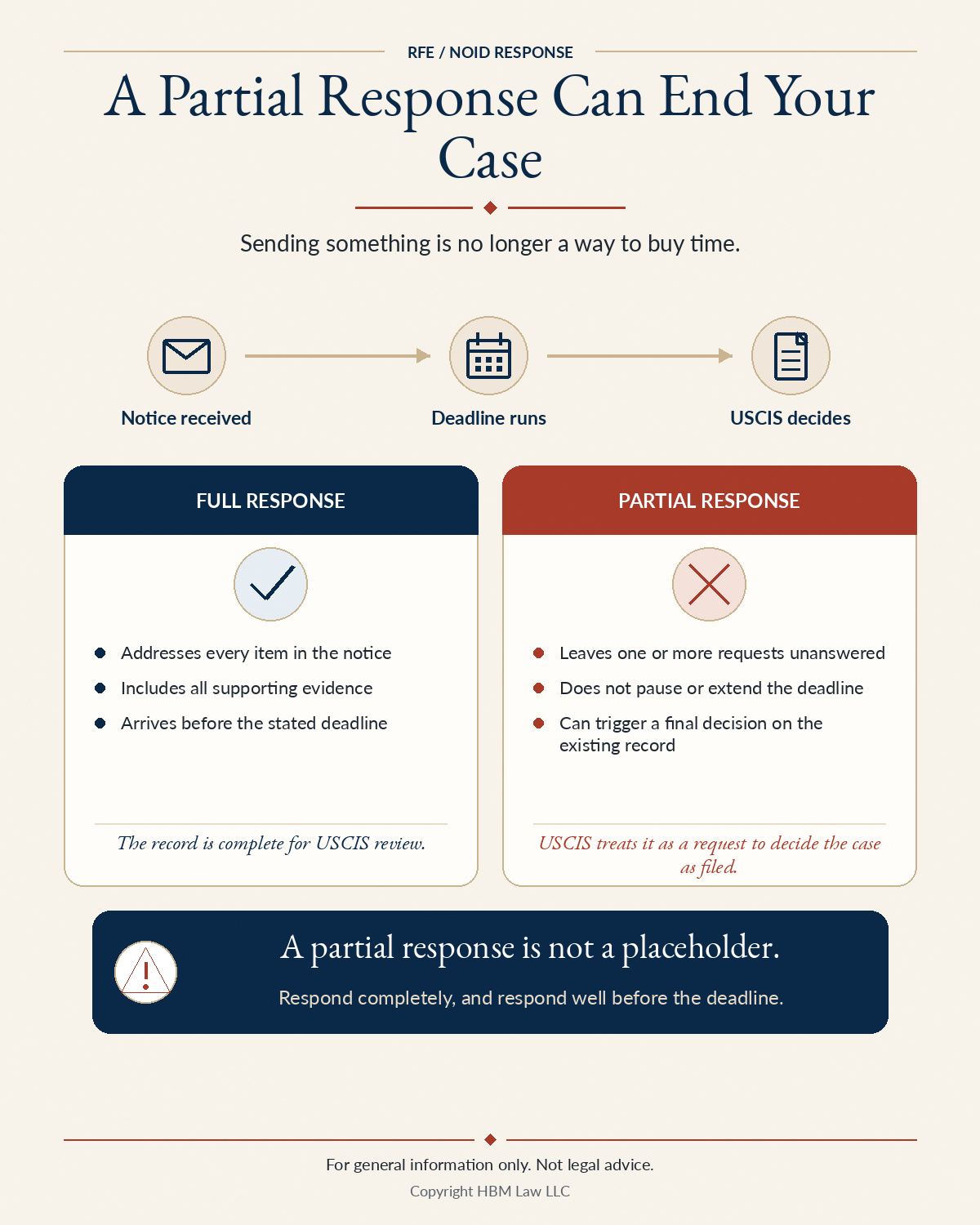
One more change deserves attention: if you send a partial response to an RFE or NOID, USCIS treats it as a request for a final decision on what is in the file. Sending something is no longer a way to buy time.
Why this matters
The burden of proof in immigration filings has always sat with the applicant, but the process used to forgive gaps. It no longer does. A denial costs the filing fees, months of waiting, and in some situations can have consequences for a person’s status. The practical rule of this new era is simple to state and demanding to execute: every filing must be complete, correct, and persuasive on day one.
The cases that feel it most
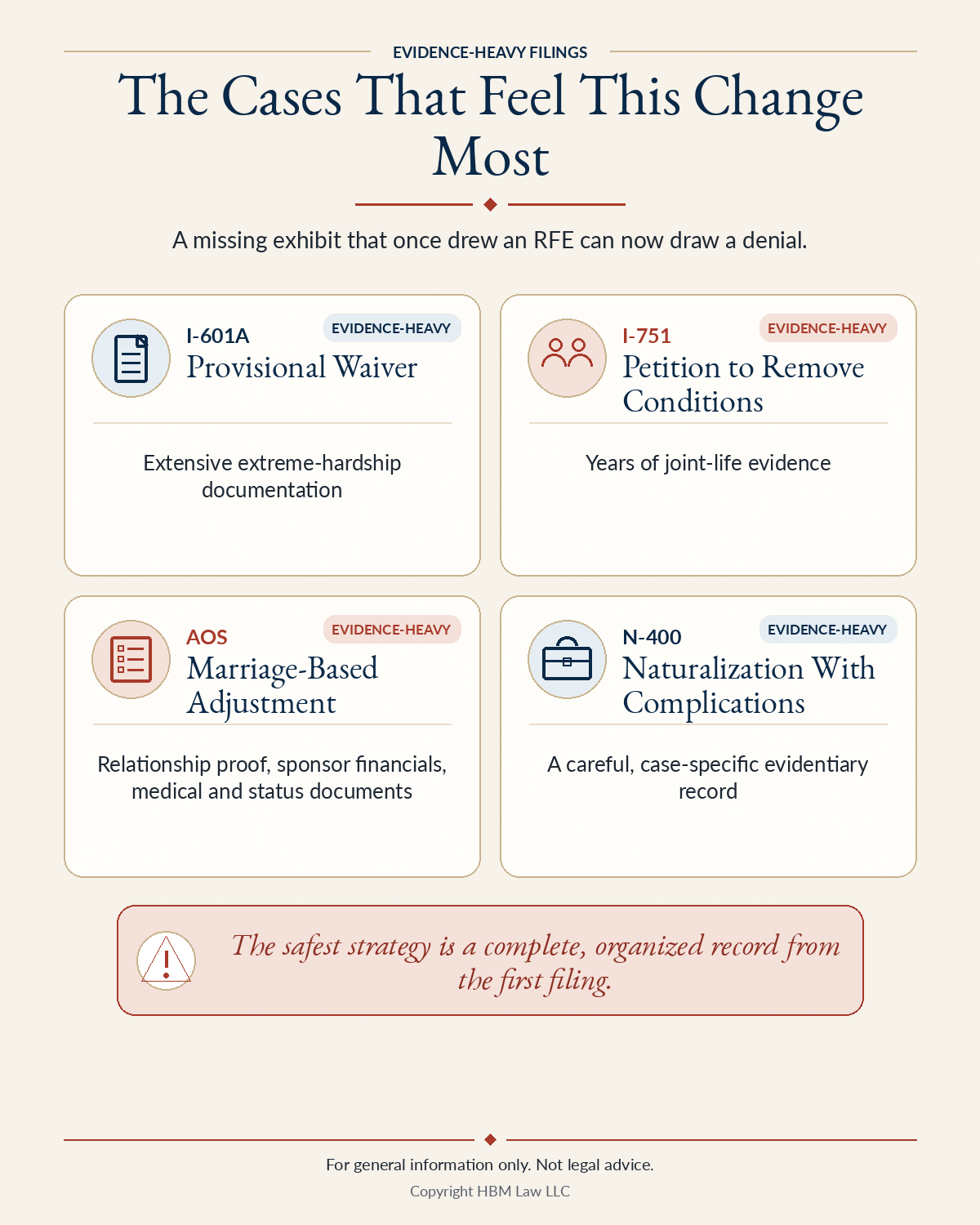
Evidence heavy filings carry the most exposure. I-601A provisional waivers rest on extensive extreme hardship documentation. I-751 petitions rest on years of joint life evidence. Marriage based adjustment filings combine relationship proof, sponsor financials, and medical and status documents, and naturalization cases with complications need their own careful record. These are exactly the cases where a missing exhibit used to draw an RFE and can now draw a denial.
How to protect your case
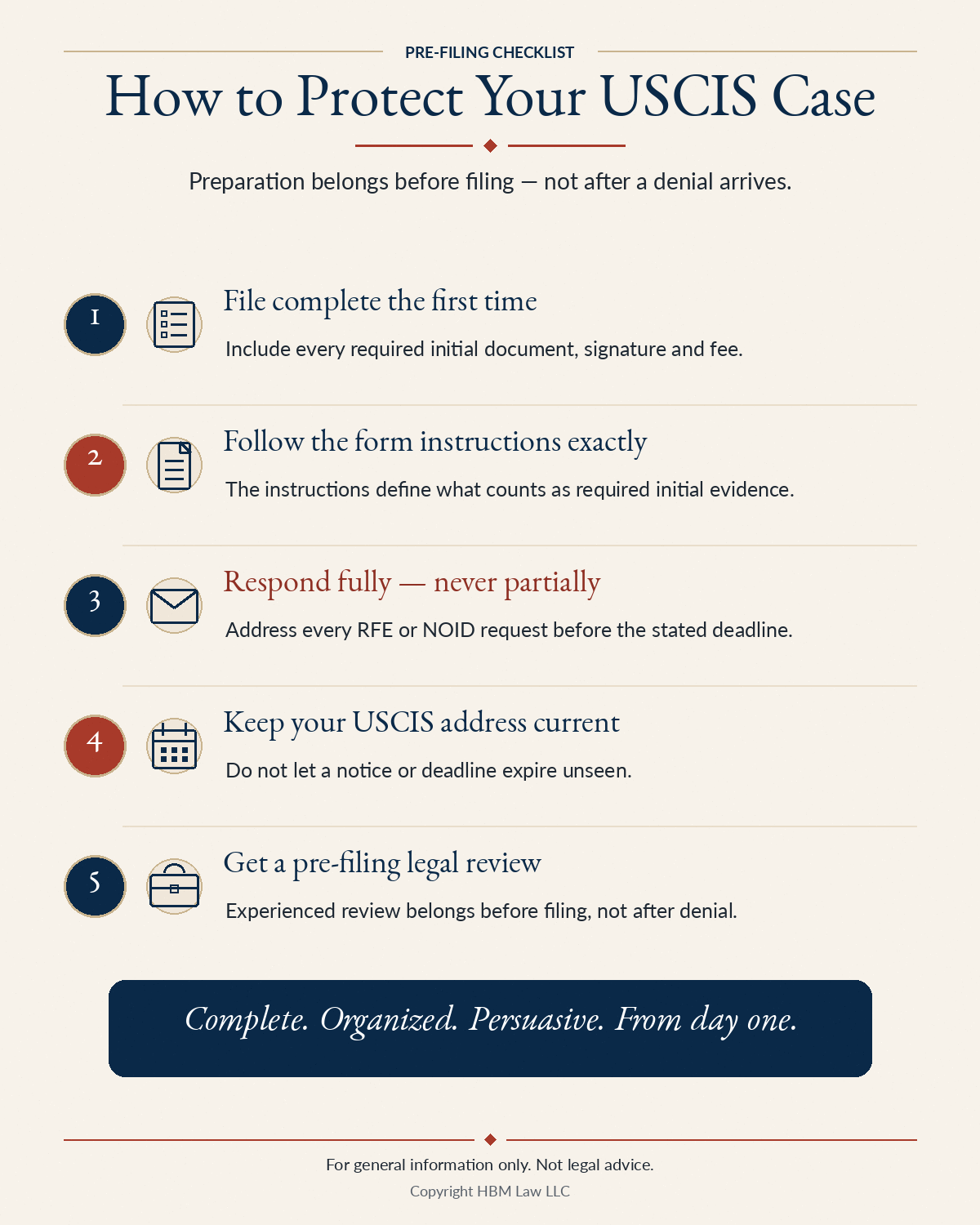
File complete the first time, following the form instructions to the letter, because the instructions define what counts as required initial evidence. If you do receive an RFE, respond fully, and never respond partially. Keep your address current with USCIS so a deadline never expires unseen. And get experienced eyes on the filing before it goes out, not after a denial arrives.
This standard is not new to our practice. Complete, organized, persuasive filings have always been how HBM Law works, and the approval letters our clients allow us to publish are the visible record of that approach. The policy change simply raises the price of doing it any other way.
Frequently asked questions
Can USCIS really deny my case without warning me first?
Yes, where required initial evidence is missing or the filing has no legal basis, the officer may deny without an RFE or NOID. Where the initial evidence is present but does not establish eligibility, an RFE or NOID may still be issued.
Does this apply to my case that is already pending?
Yes. The guidance is effective immediately and applies to benefit requests pending or filed on or after August 5, 2026.
I received an RFE. What should I do?
Treat the stated deadline as absolute, respond well before it, and respond completely. A partial response now asks USCIS to decide on an incomplete record. This is the moment to involve an attorney if one is not already involved.
The bottom line
USCIS has moved from a forgiving process to an exacting one. Preparation is no longer just good practice, it is the whole game.
Talk to us. Before you file anything with USCIS, let us review it. HBM Law Offices prepares filings built to be approved on the first attempt, and our published approvals show what that standard looks like.
Legal citation: USCIS Policy Alert PA-2026-05, Evidence, Requests for Evidence, and Notices of Intent to Deny (August 5, 2026), effective immediately; USCIS Policy Manual Volume 1, Part E.
This article provides general information about recent changes in immigration law and policy. It is not legal advice and does not create an attorney client relationship. Immigration outcomes depend on the specific facts of each case. For advice about your situation, schedule a consultation with a licensed immigration attorney.